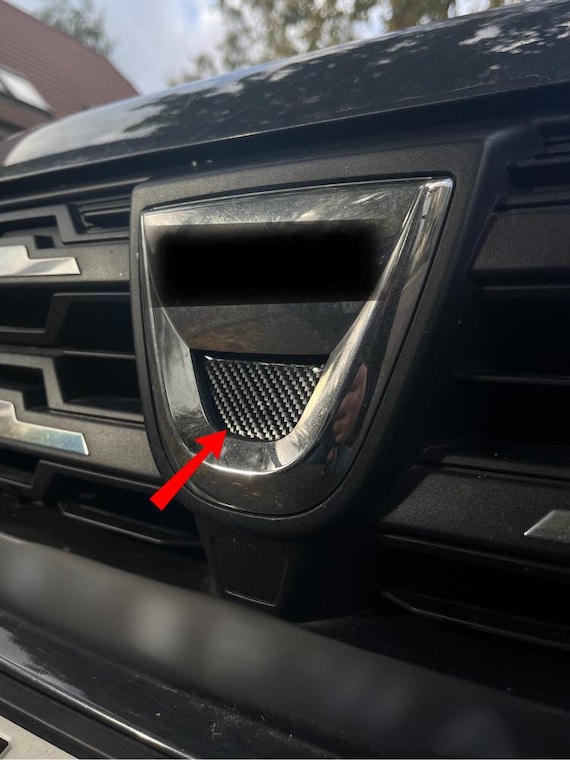
This case shows how Himgo supported a Michigan-based automotive aftermarket parts supplier in developing a front grille metal emblem for pickup truck branding kits.
The project focused on high-speed airflow stability, adhesive shear resistance, curved-surface mounting, and repeatable installation. The final solution used a zinc alloy die-cast emblem with chrome plating, black paint infill, acrylic foam adhesive, and positioning pins.
Project Overview
| Industry | Automotive aftermarket |
| Location | Michigan, USA |
| Customer Type | Automotive aftermarket parts supplier |
| Business Scope | Exterior vehicle accessories for pickup trucks |
| Application | Front grille branding emblem |
| Project Nature | New product development for aftermarket kit |
| Product | Zinc alloy 3D metal emblem |
| Size | 110 mm × 32 mm |
| Thickness | 3.2 mm |
| Relief Height | 1.5 mm |
| Mounting Method | Automotive-grade acrylic foam adhesive + positioning pins |
| Surface Finish | Chrome plating + black paint infill |
| Total Lead Time | ~6 weeks |
Application Scenario
The emblem was installed on the front grille of pickup trucks, where airflow pressure, vibration, rain, dust, and heat exposure all affect long-term attachment. For automotive metal emblem applications, the front grille position requires stronger mounting control than flat rear-body branding.
- High-speed airflow up to 120 km/h
- Continuous outdoor exposure
- UV exposure during daily vehicle use
- Rain, dust, and road particle impact
- Temperature variation from -15°C to 65°C
- Slightly curved mounting surface on the grille area
Customer Requirement
The customer planned a new aftermarket branding kit and wanted to avoid a failure pattern seen in previous badge applications.
- Stable adhesion under airflow pressure
- No detachment during 120 km/h road testing
- No visible deformation after installation
- Consistent appearance across production batches
- Repeatable positioning during installation
Original Problem
The customer’s main concern came from prior badge failures on front grille applications. The previous badge depended only on adhesive backing, and the bonding area was limited by the emblem shape and grille surface curvature.
- Badge detachment at high speed
- Insufficient adhesive shear strength
- Unstable contact on curved mounting surfaces
- Difficult positioning during installation
Engineering Challenges
- Airflow shear force acting on the front grille emblem
- Limited bonding surface area behind the emblem
- Curved installation surface reducing adhesive contact
- Balancing emblem thickness, weight, and mounting strength
- Maintaining chrome and black infill appearance after road testing
Material and Process Decision
Zinc Alloy Die Casting
Zinc alloy was selected because the emblem required a physical 3D structure, stable mechanical strength, and repeatable relief detail. Die casting allowed the 1.5 mm relief structure to remain consistent across production.
3D Metal Emblem Structure
The part was manufactured as a raised custom metal emblem, not a flat sticker. The 3.2 mm total thickness and 42 g weight required the mounting system to be reviewed as part of the product structure.
Chrome Plating and Black Paint Infill
Chrome plating was used for the exterior metallic appearance, while black paint infill was applied to recessed areas. The finish was controlled as part of the overall finishes and surface treatments plan.
Dual Fixing System
The original adhesive-only approach was replaced with a dual fixing system. Acrylic foam adhesive provided surface bonding, while two positioning pins improved installation repeatability and reduced movement during airflow exposure.
Adhesive Thickness Control
A 0.8 mm acrylic foam adhesive was selected to support bonding on a slightly curved surface without creating excessive visible edge height.
Key Manufacturing Parameters
| Material | Zinc alloy |
| Manufacturing Process | Die casting |
| Dimensions | 110 mm × 32 mm |
| Thickness | 3.2 mm |
| Relief Height | 1.5 mm |
| Emblem Weight | ~42 g |
| Adhesive Thickness | 0.8 mm |
| Positioning Pins | 2 pcs |
| Dimensional Tolerance | ±0.15 mm |
| Mass Production Time | 18 days |
Testing and Validation
Before mass production, Himgo supported validation through airflow, road, adhesion, and UV exposure checks. The purpose was to confirm both attachment stability and appearance after installation.
- Airflow simulation test
- High-speed road test at 120 km/h
- Adhesion shear test
- UV exposure test
- Installation repeatability check using positioning pins
Quality Control Focus
The production control focused on dimensional stability, pin position, adhesive placement, surface finish, and final appearance. These checks were handled under Himgo’s quality management process.
- Pin position and alignment inspection
- Adhesive placement and edge coverage check
- Chrome plating surface inspection
- Black paint infill appearance review
- Dimensional inspection against ±0.15 mm tolerance
- Final visual inspection before shipment
Project Results
- No detachment during high-speed testing
- Stable adhesion after 3 months of field testing
- Installation repeatability improved with positioning pins
- No visible deformation after installation
- Customer approved full batch production
When to Use This Solution
- Use when a front grille emblem is exposed to high-speed airflow
- Use when adhesive-only mounting has caused detachment risk
- Use when the installation surface is slightly curved
- Use when a heavier 3D emblem requires more stable positioning
- Use when aftermarket kits require repeatable installation by different users
FAQs
Why can front grille emblems detach at high speed?
Front grille emblems can detach when airflow shear force, surface curvature, vibration, and limited adhesive contact area exceed the mounting system’s holding strength.
Why use positioning pins together with adhesive?
Positioning pins improve installation repeatability and reduce movement risk, while adhesive provides surface bonding across the back of the emblem.
Is zinc alloy suitable for front grille metal emblems?
Yes. Zinc alloy is suitable when the emblem requires physical 3D relief, mechanical strength, and stable plating appearance.
Can adhesive-only mounting work for front grille emblems?
It can work for lighter or flatter parts, but heavier 3D emblems may need additional positioning or mechanical support depending on surface shape and airflow exposure.
What should be tested before mass production?
Airflow simulation, road testing, adhesive shear testing, UV exposure, and installation repeatability should be reviewed before mass production.
Need to Review a Similar Front Grille Emblem Project?
Send your emblem size, material, finish, mounting method, quantity, and application environment for engineering review.
Request Samples Request a Project Proposal