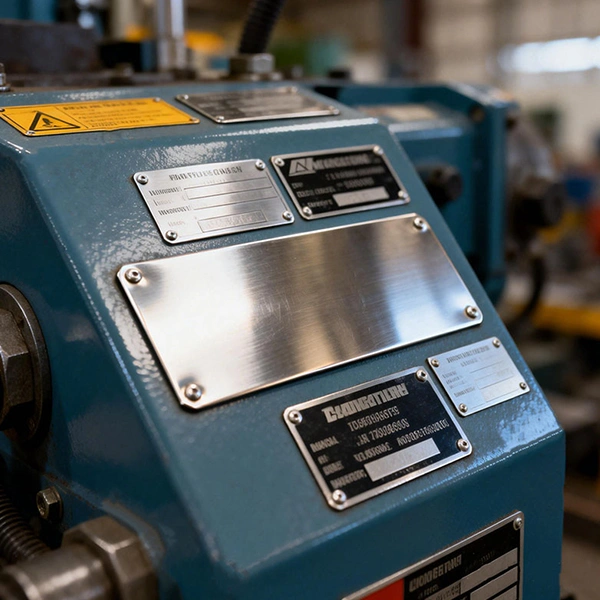
Metal identification components are widely used in industrial equipment for product identification, asset tracking, safety labeling, and compliance marking.
Typical applications include:
- equipment nameplates
- industrial metal labels
- asset identification tags
- machine specification plates
Unlike consumer applications, industrial environments often involve high temperature, chemical exposure, abrasion, and long service life requirements.
Because of these conditions, selecting the appropriate material and manufacturing method is critical to ensure long-term readability and performance.
Himgo supports industrial projects by reviewing application environments, recommending suitable materials and processes, and ensuring stable production for consistent and durable results.
Industrial Environment Challenges
Industrial identification components must perform reliably under demanding operating conditions.
1.High Temperature Exposure
Industrial equipment may operate under elevated temperatures.
| Condition | Typical Range |
|---|---|
| Operating temperature | 80–150°C |
| Extreme environments | up to 870°C |
Requires heat-resistant materials such as stainless steel
2.Chemical Exposure
Industrial environments may include:
- oils and lubricants
- cleaning agents
- acids and alkalis
Materials must resist corrosion and surface degradation
3.Long-Term Readability
Industrial labels are expected to remain readable for:
| Application | Expected Duration |
|---|---|
| Standard industrial use | 5–10 years |
| Heavy-duty environments | 10–20+ years |
Requires permanent marking methods such as etching or engraving
4.Mechanical Wear
Labels may be exposed to:
- abrasion
- pressure washing
- friction
Surface marking must resist wear over time
Common Failure Risks in Industrial Labeling
Incorrect material or process selection can lead to performance issues in real applications.
Typical Failure Cases
- printed labels fade within 6–12 months
- adhesive failure in oily or rough surfaces
- aluminum corrosion in chemical environments
- laser marking becomes unreadable under abrasion
Root Causes
| Issue | Cause |
|---|---|
| Fading | Ink-based printing not suitable for environment |
| Peeling | Incorrect adhesive selection |
| Corrosion | Material mismatch |
| Wear | Insufficient marking depth |
These risks are commonly observed when industrial requirements are not properly evaluated
Recommended Industrial Identification Solutions
Solutions are typically selected based on environment and durability requirements.
Industrial Metal Labels
Used for:
- equipment labeling
- safety identification
- compliance labels
Engraved / Etched Metal Nameplates
Used for:
- permanent identification
- harsh environments
- long-term readability
Metal Asset Tags
Used for:
- inventory management
- asset tracking
- serial identification
Process Selection Guide
Selecting the correct manufacturing method is critical.
| Requirement | Recommended Process |
|---|---|
| Long-term durability | Chemical etching / engraving |
| High detail graphics | Printing / electroforming |
| Harsh environment | Stainless steel etching |
| Variable data (serials, QR) | Laser engraving |
Helps match process with application needs
Material & Durability Overview
Material Comparison
| Material | Key Advantage | Typical Use |
|---|---|---|
| Aluminum | Lightweight, corrosion resistant | General equipment labels |
| Stainless Steel | High temp & chemical resistance | Harsh industrial environments |
| Nickel | High precision, thin structures | Fine detail labels |
Key Material Properties
| Material | Temp Resistance | Corrosion Resistance |
|---|---|---|
| Aluminum | 150–200°C | Good |
| Stainless Steel | up to 870–925°C | Very high |
| Nickel | ~300–400°C | High |
Expected Service Life
Service life depends on material and environment.
| Material / Method | Typical Lifespan |
|---|---|
| Printed labels | 1–3 years |
| Anodized aluminum | 3–7 years |
| Stainless steel etched | 10–20+ years |
Proper selection significantly reduces replacement cost
Compliance & Identification Standards
Industrial identification often requires compliance with international standards.
Common Standards
- UL (safety certification)
- CE (European compliance)
- RoHS (material safety)
- REACH (chemical compliance)
Identification Requirements
Industrial labels may include:
- serial numbers
- barcodes
- QR codes
- variable data
Typically applied via laser engraving or etching
Industrial Case Example
Application
Heavy equipment manufacturer
Requirement
Durable nameplates for outdoor machinery
Challenge
exposure to oil and weather
long-term readability required
Solution
stainless steel etched plates
deep marking for durability
Result
service life extended beyond 10 years
improved readability in harsh environments
Industrial Equipment FAQs
What is the best material for industrial labels?
Stainless steel is typically preferred for harsh environments, while aluminum is suitable for general applications.
Can metal labels withstand high temperatures?
Yes. Stainless steel labels can withstand temperatures up to 870°C depending on application conditions.
How are serial numbers or QR codes applied?
Common methods include laser engraving, chemical etching, and printing depending on material and durability requirements.
How long do industrial metal labels last?
Depending on materials and environment, lifespan can range from 3 years to over 20 years.
What is the typical production lead time?
Sample: 5–7 days
Mass production: 12–30 days
Discuss Your Industrial Identification Project
If you are evaluating metal labels, nameplates, or asset tags for industrial equipment, our team can review your requirements and suggest suitable materials and manufacturing processes.