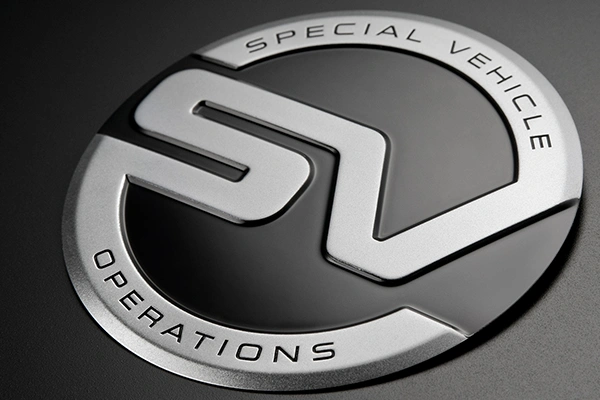
This case shows how Himgo supported a German automotive supplier in resolving corrosion, coating instability, and adhesive failure issues for an outdoor vehicle emblem used in automotive branding applications.
The final solution achieved 500-hour ASTM B117 salt spray performance, stable color consistency, and reliable adhesion under low-temperature conditions.
Project Overview
| Industry | Automotive |
| Location | Germany |
| Customer Type | Tier 2 automotive component supplier |
| Product | Zinc alloy 3D metal emblem |
| Application | Tailgate branding badge |
| Size | 85 × 28 mm |
| Thickness | 2.5 mm |
| Relief Height | 1.2 mm |
| Mounting | 3M VHB adhesive |
| Lead Time | ~6 weeks |
Application Scenario
The emblem is installed on vehicle tailgates and exposed to continuous outdoor conditions. For this type of custom metal emblem, both surface durability and brand appearance consistency must be controlled during production.
- Road salt exposure in winter
- UV exposure under European climate
- Temperature range from -20°C to 60°C
- Rain, humidity, and moisture cycles
- High-pressure washing with detergents
Customer Problem
- Corrosion appeared after 3–4 months
- Black coating faded under UV exposure
- Color inconsistency between batches
- Adhesive detachment in winter conditions
Engineering Challenges
- Balancing corrosion resistance and appearance
- Ensuring UV stability of coating
- Maintaining batch color consistency
- Achieving stable adhesion at low temperature
- Controlling die casting surface defects
Material & Process Decision
Zinc Alloy Material
Zinc alloy was selected to achieve a true 3D structure and stable geometry across batches. Compared with flat aluminum or stainless steel plates, zinc alloy die casting is better suited when the emblem needs visible relief and stronger dimensional depth.
Die Casting Process
Die casting was selected to produce the 1.2 mm relief height with consistent dimensional control. This process supports repeatable 3D emblem production where batch consistency matters.
Nickel Electroplating: 10–15 μm
Nickel electroplating improves corrosion resistance under salt exposure conditions. For this project, plating thickness control was part of the surface protection strategy.
UV-Resistant Coating
A UV-resistant black coating was used to reduce fading risk under outdoor exposure. The coating process was managed together with other finishes and surface treatments to balance visual consistency and durability.
3M VHB Adhesive: 0.8 mm
The adhesive system was selected for painted automotive surfaces and temperature variation. The target was stable bonding under low-temperature conditions without increasing visible edge thickness.
Key Manufacturing Parameters
- Relief Height: 1.2 mm
- Tolerance: ±0.15 mm
- Electroplating: 10–15 μm
- Adhesive Thickness: 0.8 mm
- Salt Spray: 500-hour ASTM B117
Testing & Validation
Before mass production, the project went through testing and inspection under Himgo’s quality management process.
- Salt spray test according to ASTM B117
- UV aging test
- Coating adhesion test
- Adhesive peel strength test
- 100% visual inspection
Results
- Passed 500-hour salt spray test
- Color variation controlled within ΔE < 1.5
- Yield rate above 98.5%
- Stable adhesion at -20°C
- No field failure after 6 months
When to Use This Solution
- Outdoor automotive applications
- Salt exposure environments
- High consistency branding requirement
- Adhesive mounting under temperature variation
- 3D emblem projects requiring stable relief structure
FAQ
Does a 500-hour salt spray test mean the emblem will last 500 hours outdoors?
No. ASTM B117 defines a controlled testing environment, not real-world service life. It is used for corrosion resistance comparison.
Why was zinc alloy selected instead of stainless steel or aluminum?
Zinc alloy allows true 3D relief structures required for automotive emblems, while stainless steel and aluminum are typically used for flat or low-relief parts.
How is color consistency controlled across batches?
Color consistency is controlled through plating thickness control, coating process standardization, and inspection. This project maintained variation within ΔE < 1.5.
Will the adhesive fail under low temperatures?
The selected 3M VHB adhesive system remained stable under -20°C test conditions.
Is plating thickness important for corrosion resistance?
Yes. A controlled 10–15 μm nickel layer improves corrosion resistance while maintaining the required surface finish.
Related Solutions
Explore related product, material, and manufacturing pages for similar projects:
- Custom Metal Emblems
- Zinc Alloy for 3D Metal Emblems
- Automotive Industry Applications
- Manufacturing Capabilities
Need an outdoor automotive emblem solution with corrosion resistance, color consistency, and stable mounting?
Request a Sample Get a Quote