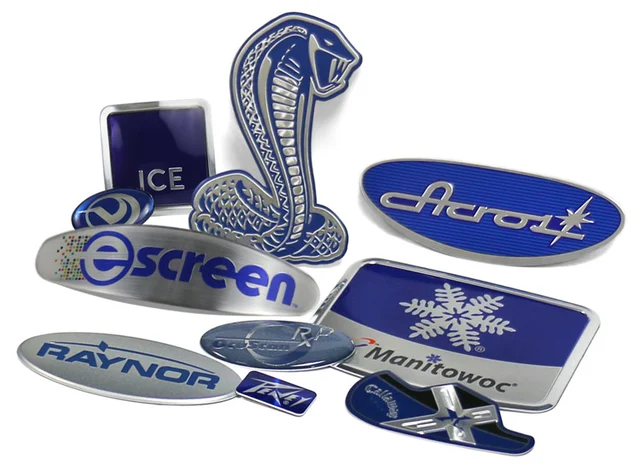
This case shows how Himgo supported a Texas-based automotive aftermarket branding supplier in solving adhesive failure on thin aluminum metal stickers installed on vehicle side body panels.
The final solution used 0.4 mm aluminum 5052, brushed finishing, clear protective coating, backside surface activation, and a 1.0 mm acrylic foam adhesive system to improve bonding stability on curved vehicle surfaces.
Project Overview
| Industry | Automotive aftermarket |
| Location | Texas, USA |
| Customer Type | Automotive aftermarket branding supplier |
| Application | Side body decorative metal logo for pickup trucks and SUVs |
| Product | Thin aluminum metal sticker |
| Project Nature | Adhesive failure issue with existing supplier |
| Size | 120 mm × 35 mm |
| Material Thickness | 0.4 mm |
| Mounting | Adhesive backing |
| Surface Finish | Brushed aluminum + clear protective coating |
| Total Lead Time | ~5 weeks |
Application Scenario
The product was used as a side body decorative logo for pickup trucks and SUVs. For this type of custom metal sticker, the main risk is not the metal part itself, but whether the adhesive system can remain stable on curved painted panels under outdoor exposure.
- Full-time outdoor exposure
- Vehicle surface temperature up to 70°C
- High UV exposure in the southern United States
- Regular washing with pressure and detergent
- Installation on slightly curved vehicle side panels
Customer Problem
The customer approached Himgo after repeated field issues with the existing supplier. The failure usually appeared after installation, not during initial inspection.
- Adhesive failure within 2–3 months
- Edge lifting on curved panels
- Reduced bonding strength under heat
- Inconsistent adhesion between production batches
Root Cause Analysis
The project review showed that the original issue was not caused by one single factor. The metal sticker was thin, the vehicle surface had slight curvature, and the adhesive layer did not provide enough gap filling under heat and surface variation.
- The adhesive layer was too thin for curved panel tolerance
- Heat softened the adhesive and reduced edge holding strength
- Backside surface preparation was not consistent before lamination
- Installation contamination reduced bonding performance in the field
Engineering Challenges
- Improving adhesion on slightly curved painted metal surfaces
- Reducing heat-induced adhesive softening
- Maintaining a thin metal appearance without losing bonding strength
- Improving consistency during adhesive lamination
- Reducing edge lifting risk after outdoor installation
Material and Process Decision
Aluminum 5052 Material
Aluminum 5052 was selected because the part needed a thin and lightweight structure with enough flexibility for curved body panels. The 0.4 mm thickness helped the sticker conform better than thicker rigid metal plates.
Brushed Aluminum Finish
The brushed surface was selected for vehicle exterior branding where a metallic texture was required without using a thick 3D emblem structure. The finish was combined with a clear protective coating to improve scratch resistance during handling and washing.
Clear Protective Coating
The coating was applied to protect the brushed finish from surface wear and cleaning exposure. This finish belongs to the broader category of finishes and surface treatments used to balance appearance and durability.
Adhesive System Upgrade
The adhesive was upgraded to a 1.0 mm acrylic foam adhesive system. Compared with a thinner adhesive layer, this provided better gap filling and flexibility on curved painted panels.
Backside Surface Activation
Before adhesive lamination, the backside of the aluminum sticker was treated to improve bonding consistency. This step reduced the risk of uneven adhesion between batches.
Key Manufacturing Parameters
| Material | Aluminum 5052 |
| Metal Thickness | 0.4 mm |
| Adhesive Thickness | 1.0 mm |
| Long-Term Adhesive Temperature Resistance | ~90°C reference range |
| Shear Strength Reference | ~620 kPa |
| Dimensional Tolerance | ±0.10 mm |
| Sample Production | 6 days |
| Mass Production | 18 days |
Testing and Validation
Before mass production, the project went through heat, adhesion, water, and installation simulation checks. Adhesive-backed projects should be validated before batch production because field failure is often related to surface preparation and real installation conditions.
- Heat aging test at 70°C exposure
- Adhesion peel test
- UV exposure test
- Curved surface installation simulation
- Water resistance testing
Quality Control Focus
The main inspection focus was adhesive lamination consistency, edge condition, surface finish, and dimensional accuracy. These checks were handled under Himgo’s quality management process.
- Backside surface condition before adhesive lamination
- Adhesive alignment and edge coverage
- Surface scratch and coating inspection
- Dimensional inspection against ±0.10 mm tolerance
- Batch-level adhesion consistency review
Project Results
- No edge lifting after 6-month field testing
- Adhesion stability maintained under high-temperature exposure
- Installation success rate improved to above 99%
- Batch adhesion consistency improved after backside treatment
- The customer replaced the previous supplier for full production
When to Use This Solution
- Use when a metal sticker must be installed on curved vehicle body panels
- Use when outdoor heat exposure may weaken adhesive strength
- Use when edge lifting has occurred with previous adhesive-backed parts
- Use when a thin brushed metal appearance is required instead of a thick emblem
- Use when batch adhesion consistency matters for aftermarket branding kits
FAQ
Why do adhesive-backed metal stickers lift at the edges?
Edge lifting can occur when the adhesive layer cannot absorb surface curvature, heat expansion, or installation surface variation.
Why was 1.0 mm adhesive selected for this project?
A 1.0 mm acrylic foam adhesive provides better gap filling and flexibility on slightly curved vehicle panels.
Is aluminum suitable for vehicle body metal stickers?
Yes. Aluminum 5052 is lightweight, thin, and flexible enough for adhesive-backed metal stickers used on vehicle body panels.
Can brushed aluminum be used outdoors?
Yes, but a protective coating is recommended when the part is exposed to washing, UV, and handling.
Should adhesive performance be tested before mass production?
Yes. Heat aging, peel testing, water exposure, and curved-surface simulation help reduce field failure risk.
Related Solutions
Explore related product, material, and manufacturing pages for similar adhesive-backed metal branding projects:
- Custom Metal Stickers
- Automotive Industry Applications
- Aluminum and Aluminum Alloys
- Finishes and Surface Treatments
- Manufacturing Capabilities
Need adhesive-backed metal stickers for vehicle body panels or outdoor branding kits?
Request a Sample Get a Quote