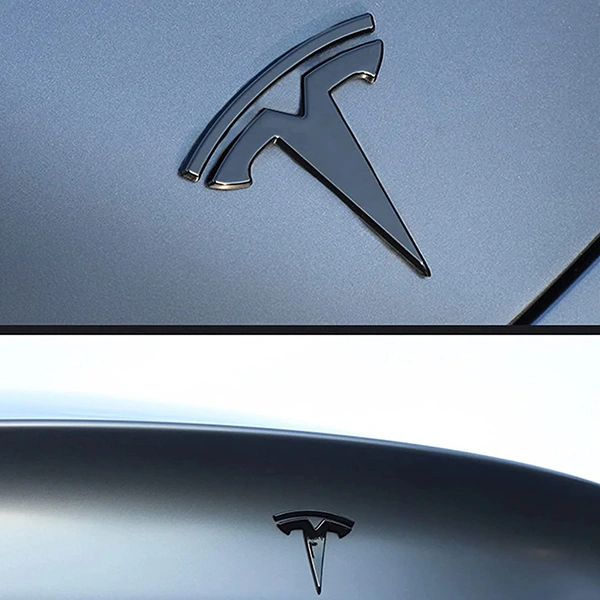
Metal identification components are widely used in automotive manufacturing and aftermarket applications for both branding and product identification.
Typical automotive applications include:
- vehicle brand emblems
- grille badges
- trim branding components
- engine compartment identification plates
Although these components may appear simple, they must perform reliably under demanding conditions including outdoor exposure, temperature variation, and mechanical vibration.
Himgo supports automotive projects by reviewing application requirements, recommending suitable materials and processes, and ensuring stable production for consistent results.
Automotive Industry Challenges
Automotive identification components must meet specific performance requirements that are often more demanding than standard industrial applications.
1.Outdoor Exposure & Corrosion
Vehicles are continuously exposed to:
- UV radiation
- rain and moisture
- road salt
- temperature changes
Typical durability requirement
| Test Standard | Industry Range |
|---|---|
| Salt Spray (ASTM B117) | 500–1000 hours |
Used to evaluate corrosion resistance of plated surfaces
2.Plating Finish Consistency
Common finishes include:
- chrome plating
- nickel plating
- black chrome
- satin finishes
Typical production challenges
- color variation between batches
- uneven plating thickness
- surface haze
Especially critical for automotive branding consistency
3.Mounting Reliability
Vehicle movement introduces continuous vibration, requiring secure mounting solutions.
Common mounting methods
- adhesive backing
- pins
- clips
Typical adhesive performance
| Property | Value |
|---|---|
| Shear strength | ~620 kPa |
| Long-term temperature | ~93°C |
Ensures long-term stability under vibration
Recommended Automotive Identification Solutions
Different automotive applications require different product types.
Custom Metal Emblems(Exterior Branding)
Typical applications:
- vehicle logos
- grille emblems
- aftermarket badges
Key parameters
| Parameter | Range |
|---|---|
| Thickness | 2–5 mm |
| Relief height | 0.5–3 mm |
| Tolerance | ±0.10–0.20 mm |
Suitable for fine-detail branding
View Metal EmblemsAutomotive Nameplates(Identification)
Typical applications:
- engine labels
- specification plates
- compliance identification
Typical specifications
| Parameter | Range |
|---|---|
| Thickness | 0.3–3 mm |
| Max size | ~600 mm |
| Tolerance | ±0.10 mm |
Suitable for long-term identification
View Automotive NameplatesMetal Logo Stickers(Interior Branding)
Typical applications:
- dashboard logos
- trim branding
- interior badges
Electroforming capability
| Parameter | Value |
|---|---|
| Thickness | 0.05–0.30 mm |
| Min detail | 0.05 mm |
| Tolerance | ±0.02 mm |
Suitable for fine-detail branding
View Metal Logo StickersMaterial Selection Overview
Material selection directly affects durability and performance.
Material Comparison
| Material | Key Advantage | Typical Use |
|---|---|---|
| Aluminum | Lightweight, corrosion resistant | Interior & engine labels |
| Stainless Steel | High temperature resistance | Harsh environments |
| Zinc Alloy | Supports 3D structures | Automotive emblems |
Key Material Properties
| Material | Temp Resistance | Corrosion Resistance |
|---|---|---|
| Aluminum | 150–200°C | Good |
| Stainless Steel | up to 870–925°C | Very high |
| Zinc Alloy | ~120°C | Good |
Quick Selection Guide
| Application Scenario | Recommended Solution |
|---|---|
| Exterior branding (vehicle body) | Die-cast metal emblems |
| Interior branding (dashboard / trim) | Metal logo stickers |
| Identification (engine / equipment) | Metal nameplates |
Helps quickly determine the suitable product type
Automotive Case Example
Customer
European aftermarket automotive parts supplier
Requirement
Custom grille emblems for new product line
Challenge
inconsistent chrome finish from previous suppliers
batch variation in plating
Solution
zinc alloy die casting
controlled electroplating
tolerance control within ±0.15 mm
Result
50,000 pcs stable production
consistent finish across batches
How Automotive Projects Move from Design to Delivery
Most automotive projects we support follow a clear, proven path:
1.Design & Application Review
We review drawings, references, and how the part will be installed and used.
2.Solution Confirmation
Materials, finishes, and attachment methods are aligned with real vehicle conditions.
3.Sample Development & Approval
Samples confirm appearance, performance, and expectations.
4.Production & Consistency Control
Production follows confirmed standards to ensure repeatability.
4.Delivery & Ongoing Support
Parts are delivered on schedule, with support for future production cycles.
This process helps automotive teams maintain confidence across long program lifecycles.
What We Review Before Automotive Program Manufacturing
Before production begins, we typically confirm:
| Review Point | Why It Matters |
|---|---|
| Exposure conditions | Ensures long-term durability |
| Appearance expectations | Aligns samples with mass production |
| Installation method | Prevents vibration-related issues |
| Program continuity | Supports future vehicle variants |
These reviews are part of our normal manufacturing workflow.
Application Fit Check – Automotive Projects
Many automotive teams confirm the following before moving forward:
- ☐ Installation location is clearly defined
- ☐ Exposure conditions are understood
- ☐ Appearance consistency is critical
- ☐ Repeat production is expected
If these apply, an application review helps clarify next steps.
Automotive Industry FAQ
What materials are commonly used for automotive emblems?
Zinc alloy is commonly used because it supports detailed 3D structures and electroplated finishes.
Do automotive badges require corrosion testing?
Yes. Typical salt spray testing ranges from 500–1000 hours.
What mounting methods are used for vehicle badges?
Common options include adhesive backing, pins, and clips depending on installation requirements.
Can metal nameplates be used in engine compartments?
Yes. Aluminum and stainless steel are commonly used due to temperature and chemical resistance.
What is the typical production lead time?
Sample: 5–7 days
Mass production: 12–30 days
Discuss Your Automotive Identification Project
If you are evaluating metal emblems, nameplates, or branding components for automotive applications, our team can review your requirements and suggest suitable manufacturing options.